The Ultimate Human: Learning from the Abilities of Living Beings
Today, humans solve the problem of transportation by creating scooters, cars, buses, trains, ships and airplanes to take us from one place to another. These are remarkable inventions, but perhaps they are not the ultimate solution. Nature already provides examples of living beings that move freely through different environments: birds have wings and can fly, fish can swim, cheetahs can run at extraordinary speeds, and many animals can travel, climb, jump or glide without machines. This raises an inspiring question: instead of continually creating external machines to give humans abilities that other living beings naturally possess, Can we learn from nature and develop the human body itself to possess some of these extraordinary abilities?
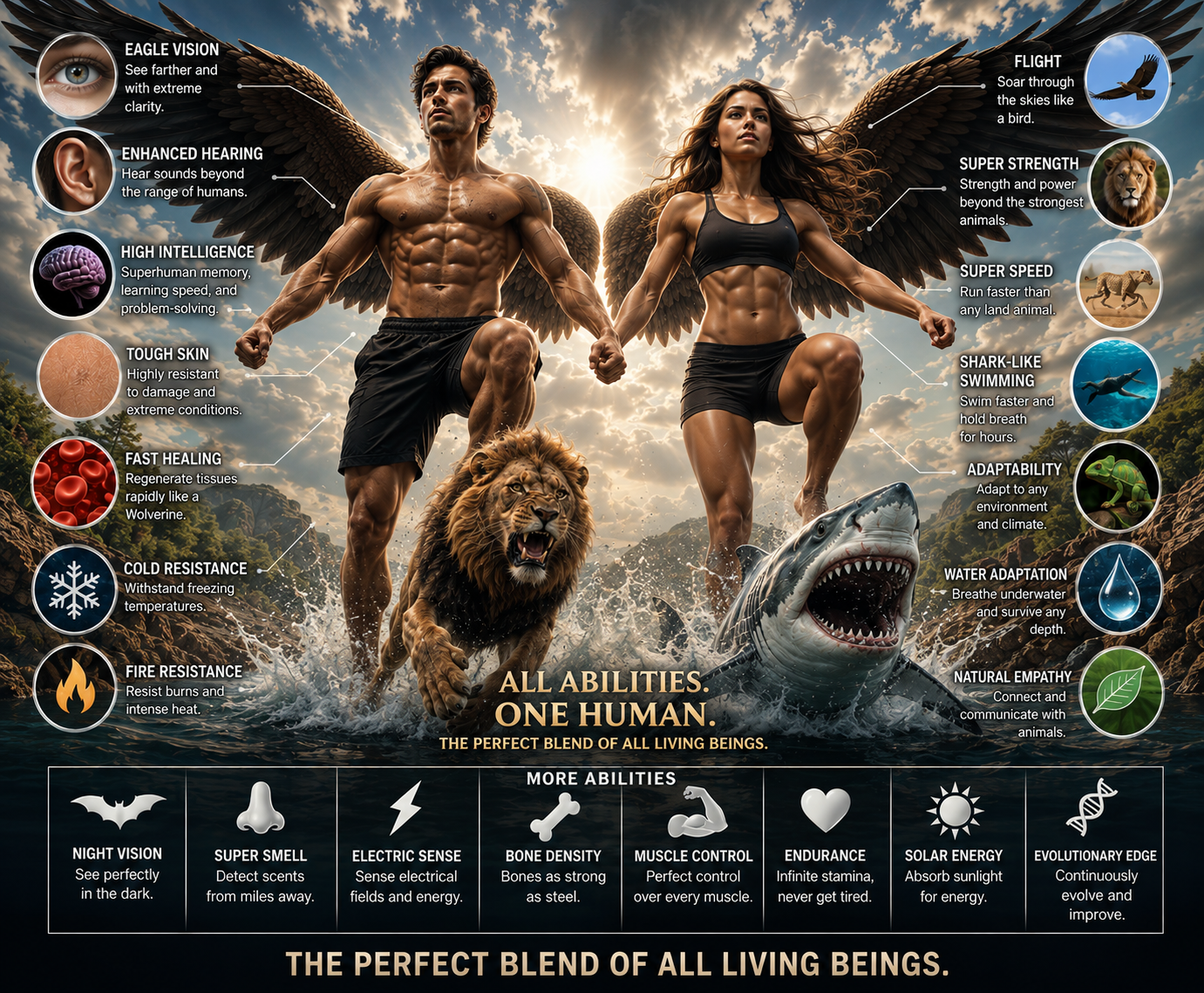
Imagine a future human being with the wings and vision of a bird, the strength of a lion, the speed of a cheetah, the swimming ability of a shark, the endurance of a horse, the adaptability of a chameleon, the extraordinary senses of different animals, and powerful natural healing abilities. Combined with human intelligence, creativity, communication, emotions and compassion, such a person could move through the world with far less dependence on external machines. The goal would not simply be to create a “superhuman,” but to understand and reproduce the remarkable solutions that nature has developed through living organisms.
This thought also encourages us to look at nature differently. Every species has developed abilities that help it survive and thrive—some can see in darkness, withstand extreme temperatures, sense their surroundings, regenerate tissues, navigate enormous distances or survive in environments where humans cannot. Perhaps nature is not only something for us to observe; it is also a source of knowledge and inspiration. By studying these abilities responsibly through biology, medicine, biotechnology, engineering and other sciences, humanity may one day discover new ways to enhance human capabilities while protecting and respecting the diversity of life.
Ultimately, the idea is to imagine a human being who carries the best abilities found throughout the living world, while retaining the qualities that make humanity unique. It is a vision of learning from creation rather than merely building machines to compensate for our limitations—a question for the future: Can humanity evolve, through science and knowledge, from simply inventing tools that imitate nature to understanding and embodying nature's extraordinary abilities?