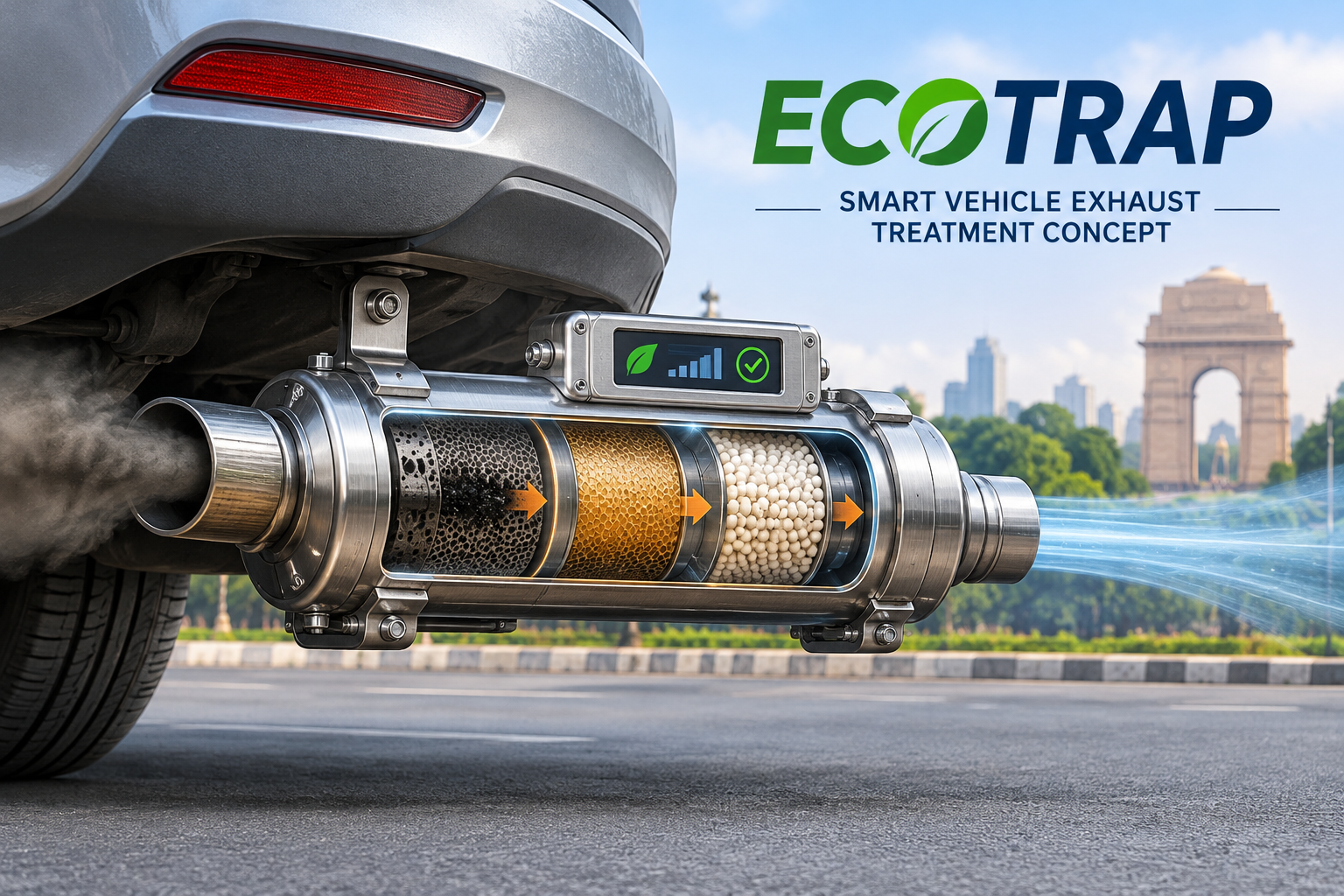
Proposed invention · Research concept
EcoTrap
Smart Vehicle Exhaust Treatment & Pollution Capture Concept
Could a compact, modular device help capture soot and reduce harmful pollutants before vehicle exhaust enters the air? EcoTrap is a proposed research and engineering concept exploring that possibility.
Important scientific note: EcoTrap is an idea under development, not a tested or commercially available product. It does not yet demonstrate zero-emission exhaust. Any prototype must be independently tested for emissions, backpressure, temperature, durability, safety and compliance with applicable vehicle regulations.
1. The idea
Vehicles release a mixture of gases, water vapour and, depending on the engine and its condition, particulate matter such as soot. Some pollutants can be trapped by filters; others need catalytic or chemical treatment. Carbon dioxide is different: it is a greenhouse gas and cannot be removed by an ordinary soot filter.
EcoTrap explores whether these functions can be integrated into a compact, serviceable module for suitable vehicles. The initial research priority would be particulate capture and effective treatment of regulated exhaust pollutants. Onboard carbon-dioxide capture would remain a separate experimental research track because of its additional weight, energy, storage and regeneration requirements.
2. Proposed working architecture
Exhaust inletHot engine exhaust
Particle filterCaptures soot
Catalytic stageConverts selected gases
Optional CO₂ studyExperimental sorbent
Monitoring outletMeasure treated exhaust
1
Particle capture
A high-temperature particulate filter, such as an appropriately engineered wall-flow filter, could trap soot. Captured soot must be managed through a safe regeneration or approved service process; it must not simply accumulate in an improvised container.
2
Catalytic treatment
Suitable catalytic systems can oxidize carbon monoxide and unburned hydrocarbons. The exact catalyst and operating conditions depend on engine type, exhaust temperature and the existing after-treatment system.
3
NOx reduction
For compatible diesel applications, selective catalytic reduction (SCR) can reduce nitrogen oxides using a controlled reagent-dosing system. This is not a universal add-on and requires careful integration.
4
Experimental CO₂ capture
Researchers could evaluate solid adsorbents or mineralization approaches for a limited portion of CO₂. The module would need a realistic plan for sorbent replacement or regeneration and safe handling of captured material.
5
Smart monitoring
Sensors could monitor exhaust temperature, differential pressure and selected emissions. Warning logic would identify a blocked filter, overheating or a treatment-system fault and put the vehicle into a safe condition.
6
Safe treated outlet
The final outlet would release exhaust only after treatment. “Clean air” must not be claimed unless a certified laboratory verifies the relevant pollutants and the complete vehicle remains within legal emission limits.
3. Can exhaust smoke be frozen, compressed or turned into a solid?
Capture soot as a solid
This is the most practical starting point. Soot particles can be collected in a suitable particulate filter. The filter requires controlled regeneration and professional servicing.
Convert CO₂ into a mineral
Mineral carbonation can react CO₂ with suitable alkaline materials to form stable carbonate solids. For example: CO₂ + Ca(OH)₂ → CaCO₃ + H₂O. The reaction is scientifically established, but a vehicle-sized system faces major capacity, weight and energy constraints.
Compress exhaust gases
Compressing the full exhaust stream would require energy, pressure-rated storage and management of a large gas volume. It is not a practical first design for an ordinary passenger car.
Freeze or cool exhaust
Cooling can condense water and some components, but it will not remove all harmful gases. Very low temperatures, condensate handling, icing and energy demand make this approach unsuitable as a simple tailpipe attachment.
4. Key engineering challenges
| Challenge | Why it matters | Research response |
|---|
| Backpressure | Excess exhaust restriction can affect engine performance, fuel use and durability. | Measure differential pressure across the system at multiple engine loads; establish safe limits with automotive engineers. |
| High temperature | Exhaust systems can reach temperatures that damage unsuitable materials. | Use automotive-grade materials, thermal shielding and validated temperature controls. |
| Weight and packaging | Filters, catalysts, sorbents and storage add mass and occupy limited space. | Begin with a stationary test rig and a modular design; quantify mass and volume before vehicle trials. |
| Regeneration and maintenance | Captured soot and spent sorbents need safe handling. | Design a serviceable cartridge and documented regeneration or recycling process. |
| Real-world emissions | Performance varies with engine load, temperature, fuel and vehicle condition. | Test over representative duty cycles in an accredited emissions laboratory. |
| Legal approval | Modifying vehicle exhaust systems may affect type approval, warranty and road legality. | Consult automotive certification experts and relevant Indian authorities before any road installation. |
5. Recommended development roadmap
Phase 1 – Feasibility study
Engage automotive exhaust, emissions and materials specialists. Select one engine category and define measurable targets. Review existing DPF, catalytic-converter and SCR technology to avoid duplicating proven systems.
Phase 2 – Bench prototype
Build a stationary, instrumented exhaust-treatment rig. Do not begin with an improvised device attached to a road vehicle. Measure flow, temperature, pressure and pollutant concentrations.
Phase 3 – Independent validation
Use a qualified laboratory to compare baseline and treated emissions under repeatable test cycles. Include durability, failure-mode and safety tests.
Phase 4 – Controlled vehicle pilot
Only after engineering and regulatory review, conduct supervised trials on a suitable test vehicle with fail-safe bypass and continuous monitoring.
6. Potential research and collaboration partners
Potential institutions to approach for discussion include IIT Delhi, CSIR–NEERI, the Automotive Research Association of India (ARAI), the International Centre for Automotive Technology (ICAT), and relevant vehicle-emissions research groups. Their participation is not implied or confirmed; a formal proposal and technical review would be required.
7. What success should look like
- Verified reduction in particulate matter and selected regulated pollutants compared with the unmodified baseline.
- No unsafe increase in exhaust backpressure or engine temperature.
- No increase in fuel consumption or greenhouse-gas emissions that outweighs the measured benefit.
- Reliable operation over representative driving conditions and a defined service interval.
- Safe handling, regeneration or recycling of captured material.
- Independent test reports and a clear regulatory pathway before public-road deployment.
Help explore the EcoTrap idea
We welcome collaboration from automotive engineers, environmental scientists, materials researchers, universities, laboratories and organizations interested in evaluating practical vehicle-pollution solutions.
Concept initiator: Harprit Singh Kohli
Website: thefiveevils.com
Email: Harprit.singh.kohli@gmail.com
Phone: +91 8810571940
← Back to Our Creative Ideas